
XLNC
Excelence in all



XLNC
Example 3 - Guitar
Example article - Electric Guitar
This is an example article in HyperFluxCMS. It uses a text about a random subject and serves for you to see what your site will look like after you have published real content. The subject of this example article is the Electric Guitar.
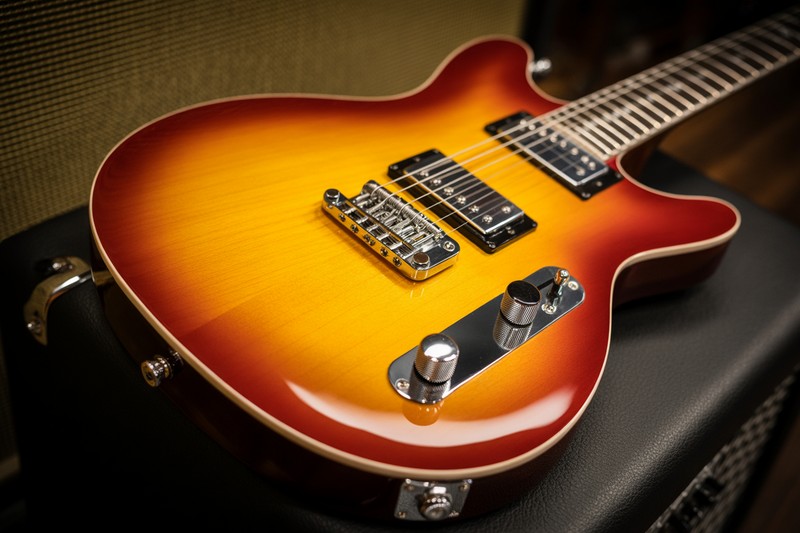
This post is an example text. It serves to show what the site will look like after you have published real content.
After your site has some pages and is ready for publication, delete this post and the other example posts.
More than just a musical instrument, the electric guitar is a cultural icon and a driving force behind some of the greatest artistic revolutions of the 20th century. Its invention, driven by the need for acoustic guitars to be heard among large big bands, culminated in the first commercially viable model by George Beauchamp and Adolph Rickenbacker in the 1930s, known as the "Frying Pan." It was, however, a quiet starting point for a future sonic explosion.
The true revolution occurred in the 1950s, with the popularization of models that would become legends. Leo Fender, with the Broadcaster (later Telecaster) and the Stratocaster, democratized access with its solid-body design and mass production. In parallel, Gibson, with the help of Les Paul, launched the iconic Les Paul, offering a fuller sound and extended sustain. These instruments defined the two aesthetic and sonic poles that would dominate rock in the following decades.
The operating principle of the electric guitar is ingenious in its simplicity. Magnetic pickups, located under the metal strings, convert mechanical vibrations into electrical signals. This signal is then sent via a cable to an amplifier, which not only projects the sound but also shapes it. The introduction of effects pedals, such as distortion, chorus, and delay, further expanded the instrument's sonic vocabulary, allowing everything from the most viscerally distorted solos to ethereal and atmospheric textures.
Culturally, the guitar became the ultimate symbol of rebellion, individual expression, and youthful energy. Stars like Chuck Berry, Jimi Hendrix, Jimmy Page, and Eric Clapton elevated the instrument to a new level, transforming it from an accompaniment to the lead voice and protagonist on stage. Its visual and sonic power embodied genres such as rock 'n' roll, blues rock, heavy metal, and punk, defining the sonic identity of entire generations.
Today, the electric guitar maintains its place, although it shares the spotlight with synthesizers and samplers. Its evolution continues with digital modelers, MIDI guitars, and expanded techniques, proving its incredible adaptability. Its legacy is an enduring testament to the power of technology applied to art, remaining not only as a musical tool but as a living legend and a blank canvas for infinite creativity.