
XLNC
Excelence in all



XLNC
Example 2 - Cotton
Example article - Cotton
This is an example article in HyperFluxCMS. It uses a text about a random subject and serves for you to see what your site will look like after you have published real content. The subject of this example article is Cotton.
This post is an example text. It serves to show what the site will look like after you have published real content.
After your site has some pages and is ready for publication, delete this post and the other example posts.
Cotton is one of the oldest and most fundamental textile fibers in human history, with records of its use dating back over 7,000 years in Peru and Pakistan. Its ability to produce fabrics that are simultaneously durable, breathable, and versatile made it a pillar of civilizations around the world, from the Indus Valley to Ancient Egypt. Its global journey, driven by trade and conquest, established it as a commodity of inestimable value, weaving itself not only into clothing but also into the very structure of economies and social relations.
The Industrial Revolution of the 18th century catapulted cotton to a new level, transforming its production and global impact. Inventions such as the Spinning Jenny and the power loom mechanized spinning and weaving, concentrating production in factories and exponentially increasing scale. This industrial boom, however, was deeply linked to one of the darkest chapters in history: the expansion of slave labor on the plantations of the Americas, which guaranteed the cheap raw material needed to feed European factories.
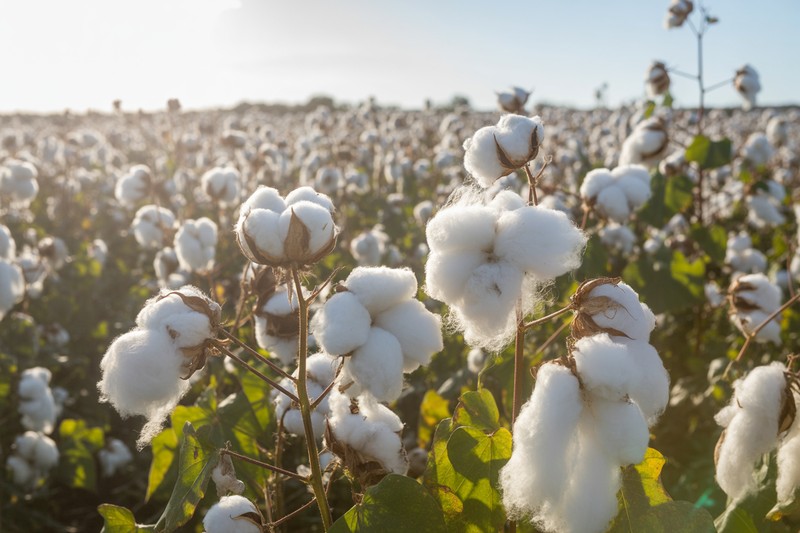
The cotton plant, of the genus Gossypium, is grown in warm climates and has a unique characteristic: the fibers we use are seeds surrounded by a mass of pure, fluffy cellulose. The process of transforming the "boll" into fabric involves several stages, from harvesting (mechanized in most countries today) to ginning (separating the fiber from the seed), spinning (which turns the fibers into yarn), and finally, weaving or knitting, which creates the fabric.
Economically, cotton remains one of the most important crops in the world, being the planet's main natural textile fiber. Its production chain, which goes from the farmer to the fashion industry, sustains millions of jobs globally, especially in developing countries. However, its traditional cultivation is often associated with significant challenges, such as intensive water and pesticide use, raising serious environmental concerns.
Currently, the cotton sector faces the urgent need to become more sustainable. Initiatives such as organic cotton (free from agrochemicals) are gaining ground, promoting practices that reduce environmental impact and improve working conditions. Its legacy is therefore twofold: it is the fabric that clothed generations and built commercial empires, but also a symbol of the challenges between global production, social justice, and ecological balance, still remaining an irreplaceable material in our daily lives.